
Fundamental Concepts About Tango Dancing
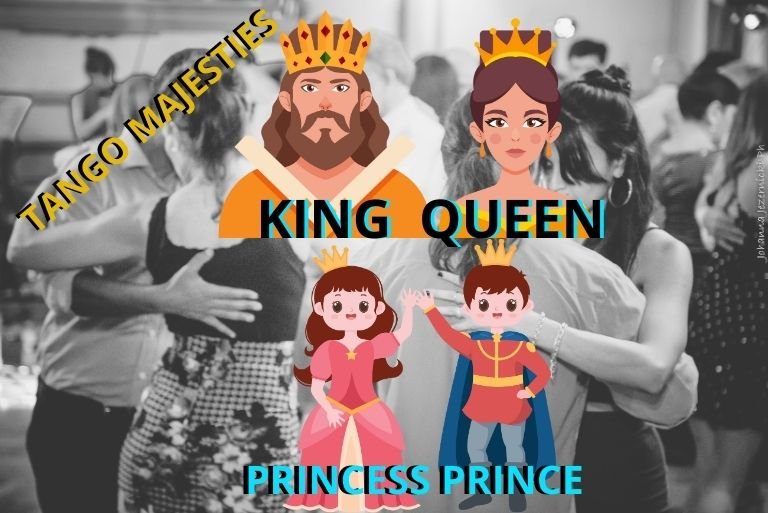
THE TANGO MAJESTIES
Before I begin sharing my experiences, I want to inform you of what, for me, is the essence of tango dancing.
Each of us is distinguished by our way of dancing, no one dances exactly like another, and we have different objectives and concepts regarding the dance.
Particularly, I have created a phrase and titled it THE MAJESTIES OF TANGO DANCING, which I repeat at every opportunity and which many teachers have asked me to show in their schools, practices, etc., for which I feel honored.
The Majesties of Tango Dancing.
THE PRINCE is the EMBRACE, THE PRINCESS is IMPROVISATION, THE QUEEN is MUSICALITY, and THE KING is FEELING.
I will not leave this definition here, because I believe that although you may intuit it, I owe you a description.
The Embrace.
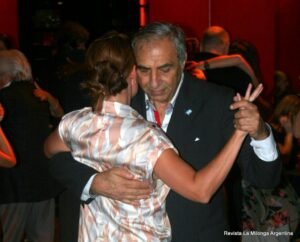
We are human beings, and the embrace belongs to us. When we meet a dear family member, a friend, someone we appreciate, we do so with an embrace. When we are sad, someone comforts us with an embrace. We embrace when we overflow with joy: our favorite team scores, we win an award, we graduate, etc. We show our love to children and parents with an embrace. We demonstrate our infatuation and affection with kisses and embraces.
Ultimately, the embrace is our form of contact to transmit a feeling. In dance, the embrace has the main role in transmitting our being, our feeling. I cannot think of anything that has an embrace as long as the 12 minutes that a tanda of 4 tangos lasts.
Furthermore, it is scientifically proven that the embrace is health:
- We secrete oxytocin and endorphins that reduce levels of cortisol and adrenaline (stress hormones) and help us feel more relaxed.
- We release serotonin and dopamine that contribute to well-being and calm.
- We activate the limbic system responsible for emotional regulation, which helps strengthen affective bonds such as trust or attachment.
For all this, THE EMBRACE IS THE PRINCE of TANGO DANCING.
Improvisation.
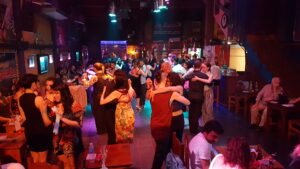
Social tango dancing, commonly called «milonguear,» is characterized by total improvisation. This improvisation is crucial for navigating the dance floor with elegance, avoiding brushes, collisions, and invasions of other couples’ space.
The sensuality and seduction of tango are not solely due to the embrace and physical contact, but also to the lead’s improvisation, a reflection of life itself. Just as in life, the follower, and especially the female gender, values emotions and is attracted to surprises. The improvisation of steps and movements by the man, or lead, generates a unique satisfaction, making the dance unforgettable for the woman.
However, improvisation must be well-received by the follower. The lead must execute it smoothly, in harmony with the music. A poorly executed improvisation, which causes collisions, is out of time, or imposes excessive force, produces the opposite effect: rejection and a negative memory.
Improvisation is also a tool of care. When dancing, leads are responsible for observing the dance floor and anticipating possible collisions, improvising changes of direction and displacements to protect our partner.
Regarding improvisation by the follower, many experienced dancers, including myself, do not receive it favorably. It interrupts the flow of the dance and disconnects us from the connection. This is why the follower is often labeled with the phrase «she moves alone,» and if she also does it out of musical time, the experience becomes even less pleasant.
My concept of follower improvisation focuses on embellishments (adornos) that must be performed within the musical time, and on expressing with the body a subtle anticipation of the lead’s direction. However, it is important to remember that most embellishments (adornos) are not for the visual enjoyment of the lead partner, as it is impossible for him to observe his partner’s feet and legs during the dance. The main objective of social tango dancing is to enrich the musical experience and emotional connection, not a display of individual skill.
Musicality.
Musicality isn’t unique to tango; it’s a fundamental principle in all dance forms.
As humans, we connect with nature, seeking it out during vacations, in our gardens, parks, and every moment of leisure. Nature attracts and delights us because, at its core, it is pure harmony.
In dance, harmony arises from moving in time with the melody, from «stepping to the rhythm.» This synchronicity is what we naturally perceive and enjoy.
Dancing detached from musical timing reduces it to a mere display of bodily skills.
Ultimately, musicality is essential for any rhythm, but in tango, it becomes a sublime expression, a true majesty.
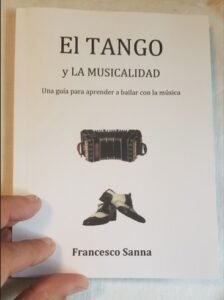
THE TANGO AND THE MUSICALITY Book in English coming soon. Ask it at tangoairesdemilonga@gmail.com spanish and italian language
Feeling.
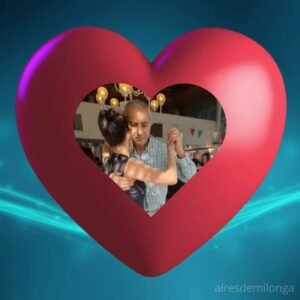
The feeling in tango is a vast and unexplored territory, a language that transcends words. Each person experiences it uniquely, like an emotional fingerprint. Trying to describe it is like trying to paint love or explain the color red to someone born blind: an almost impossible task.
However, the body speaks a universal language. The embrace, the leader’s improvisation, the guidance and containment towards the follower, the musicality, the contact and connection… all of this intertwines to weave a network of sensations that vary from person to person.
As one delves deeper into tango, one becomes an explorer of emotions. Each dance is a journey, each partner a new landscape. The search for those feelings, subtle and profound, becomes a sublime obsession. In that search, in that unique connection with each partner and in each milonga, lies the true magic of tango.
Engineer Carlos Neuman
YouTube, FaceBook, Instagram, Tik Tok: @airesdemilonga Whatsapp: +54911-27455194
ARTICLES RELATED