
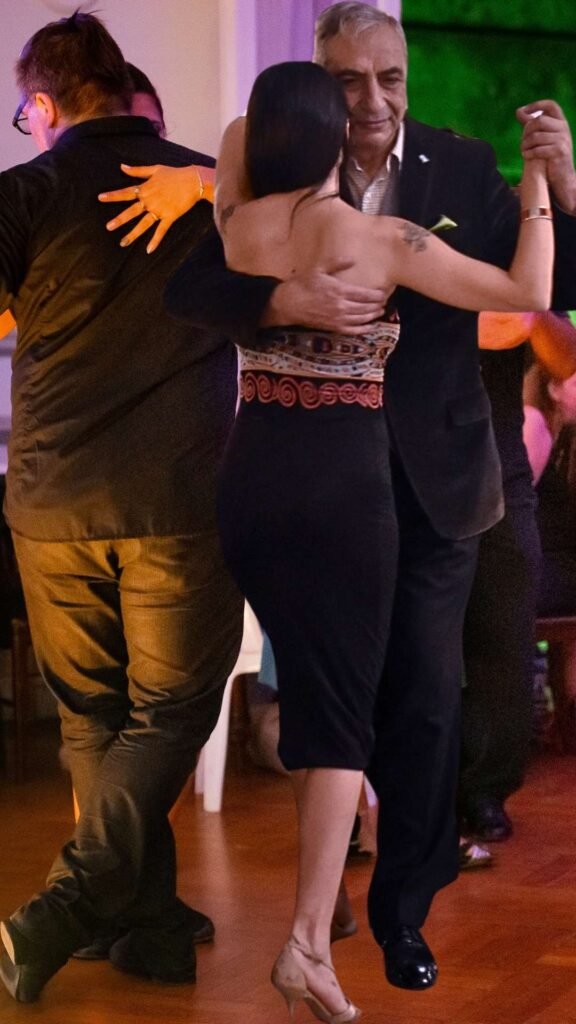
I remember my beginnings very well. My six-foot-four height was the first obstacle, not because of the height itself, but due to the poor balance resulting from a high center of gravity.
The second difficulty was executing the steps shown by the teacher and managing to master my body. I was making completely new movements; my brain didn’t know them.
The third difficulty was being embraced by a person and communicating to them, without speaking, where I wanted them to move.
The fourth obstacle was relaxing. I was tense from the moment I embraced my partner and would sweat.
The fifth difficulty was avoiding bumping knees and bodies with my partner. Every step I took seemed to push her forward. Coordinating was complicated.
As a sixth difficulty, interpreting the music and understanding the teacher who showed me how to follow the rhythm.
The seventh difficulty: mastering the free spaces to perform the learned steps.
I had been taking classes for six months. I would memorize and practice every step and sequence. In the milonga, I felt like I wasn’t dancing, but just trying to do the steps.
I wondered: Is dancing tango just doing these steps? Why did my friends’ parents dance in such a different way? What is, definitively, dancing tango? (In the end, time and the world of tango would give me the answer).
What did I have to do, and what was I missing? I didn’t have a valid reference or guide because although I knew the «world of tango,» I didn’t know what it was to dance, let alone dance well. I didn’t know the magic of the embrace or the connection, nor how to interpret the music.
Nevertheless, I knew there was a big difference between doing steps and dancing.
As I had always liked challenges, learning to dance tango was difficult for me, and that’s why it attracted me so much. I understood that it would demand time, constant will, and a lot of patience.
I had a clear r
eference: the women, including my own friend and classmate, didn’t enjoy dancing with me.
I said to myself: let’s get to work! The challenge was set. (Much later, that friend, Silvina Carina Rolandria, and I became friends and partners, and we managed to be appreciated on the dance floors).
I went to class twice a week; I had already been going for ten months and was still far from dancing.
María Lemos, Roberto Contreras’ partner (elegant and good dancers and teachers), told me then that it takes a man two years to learn to «dance well» dedicating himself a minimum of twice a week, ideally three times, and optimally four. Today I agree with them, and although the reasons are beside the point, I will describe them on another occasion.
In those days, a classmate more advanced than me, speaking about it, told me that I had to diversify my teachers because each one teaches differently, teaches what they know.
So I started going to classes in the area where I lived and then in the city of Buenos Aires. Everyone taught steps and sequences.
A year and a half had passed, and I was dedicating myself five times a week.
I knew many steps to do on the dance floor and thought I was showing off well to the people at the milonga. At that moment, I didn’t imagine that I should dance for my partner, for myself, and not for those who were watching.
With some women, I danced well (they were the ones who knew how to dance and adapt to the man), with others I didn’t (they were the ones who were still on their way, like me).
Nevertheless, I felt like I moved well, until I saw myself in a recording. It was then that I understood that what you feel is not necessarily what you see.
I had to manage to dance well with all women, not just with those who knew how to dance. Worried, I attended classes and practices with every teacher there was in Buenos Aires.
In one of the classes, I observed that the women «fought» to dance with one partner. Talking to him while we ate some empanadas, he recommended a teacher whom he considered different from the rest and with whom he had learned a lot. Without hesitation, I went to his classes.
I remember this perfectly because, effectively, with César Fernández I began to overcome several of the difficulties described before and to learn to «dance.»
Two classes a week with him and one with Mimí Santapá, who knew a lot about body language, were the new foundations for learning to dance tango well.
It was like starting over. I put aside my knowledge of steps to dedicate myself to what I now consider essential to learn first, before steps and figures: walking the tango.
With these teachers, I learned to overcome the first difficulty, performing exercises for balance and weight transfer. I also did them at home, a few minutes every day (using an alarm clock as a reminder), and which I share with you below, along with the video that helped me remember them in the early days.
BALANCE EXERCISE
Standing with your body weight distributed on both legs, slightly bend your knees, shift your body weight onto one leg, and with the other, make a loop. Without supporting it, it passes grazing the knees to take a step (only at the beginning; afterwards, it’s always two steps), and repeat with the other leg.
VIDEO HERE or copy and paste: https://www.youtube.com/watch?v=W0ZhCdEQR8k
It is important, to avoid creating a bad habit, not to do the two steps «jumping,» that is, without extending the knee of the leg that supports the body weight.
For aesthetics and form, the knee of the free leg is extended, and the leg supporting the body weight is slightly bent. The exercise should be done slowly to force the effort of balance.
WEIGHT TRANSFER EXERCISE
It is similar to the previous one: Standing with your body weight distributed on both legs, slightly bend your knees, shift your body weight onto one leg, and with the other, take a step (only at the beginning; afterwards, it’s always two steps). The other leg crosses behind (I put my foot behind the other).
I remain balanced with my body weight on the foot that had it.
The foot that is in front goes forward extending the knee (here, the transfer of body weight to the back foot is intuitively forced).
Two steps and I cross the moving foot over the heel of the supporting foot (here, the other leg crosses).
The foot that is in front goes forward extending the knee, and then again the two steps.
It is important, to avoid creating a bad habit, not to do the two steps «jumping,» that is, without extending the knee of the leg that supports the body weight.
Only the knee of the leg that is taking the step is extended. The exercise should be done slowly to force the effort of balance.
The exercise is done slowly, and as it is mastered, the speed is increased.
VIDEO Click HERE or copy and paste: https://www.youtube.com/watch?v=T7qWMvwaYmw
COMBINED EXERCISE
Combination of the balance and weight transfer exercises.
VIDEO Click HERE or copy and paste: https://www.youtube.com/watch?v=If71RhlQ1dQ
The second difficulty was the most important to overcome and was what allowed me to dance.
I learned that with the repetition of movements, I memorized them and freed up some of my mind to think about other things and even listen to the music (see DANCING TANGO. SECOND PART, The body and The effort).
Today I realize that I should have learned to walk embraced with another person before trying to do tango steps. With César Fernández, I started over, and it was more difficult because I already had bad habits.
In classes, I took every woman I could as a partner, and class after class, I walked and walked.
So much walking, being a student of the movements, allowed me to discover interesting aspects.
I discovered that the knees do not touch when the woman extends the leg that takes the step backward.
I discovered that I shouldn’t wait for the woman to take the step back on her own (even if the rhythm invites her to) and that I should avoid it by imposing my body language, helped by the embrace.
I learned that these leads and many others should be done with softness and delicacy. Learning that I appreciate from all the women who dared to tell me the magnitude of each lead.
I learned that I shouldn’t take a step forward without leading it to the woman, because I would bump into her, and that lead was basically bodily, with the intention of my body.
This is how I learned the best backward walk for the woman: with slightly bent knees, chest supported (action) on the man’s chest (reaction), and the pubis slightly facing the floor, she normally extends her leg backward with the toe grazing the floor and using the gluteal muscles more. Before reaching the end, she fully extends her leg to then transfer her body weight onto it, leaving the other leg free to take the other step in the same way.
VIDEO Click HERE or copy and paste: https://www.youtube.com/watch?v=OOGHFlkKwsI
I discovered that a woman without balance tends to lean on her arms, which forces me to hold her with strength and tires my arms.
Walking straight, in circles, stopping, and restarting the walk allowed my mind to learn and master my body.
I practiced moving and stopping my body before the woman’s, starting, stopping, and restarting the walk over and over again, giving a clear lead of intention to the woman so that we could take the step together.
VIDEO Click HERE or copy and paste: https://www.youtube.com/watch?v=3qX6r8fOGdw
Walking in small circles allowed me to master the first gentle leads to the woman, with the torso, anticipating the movement of my body with respect to my legs towards the direction of the turn, with short steps on the inside of the circle.
In the next installment, how to overcome other difficulties. By Ing. Carlos Neuman. Partial or total publication and translation permitted provided the origin and author are mentioned.
Engineer Carlos Neuman
YouTube, FaceBook, Instagram, Tik Tok: @airesdemilonga Whatsapp: +54911-27455194
ARTICLES RELATED