
The Body and Effort
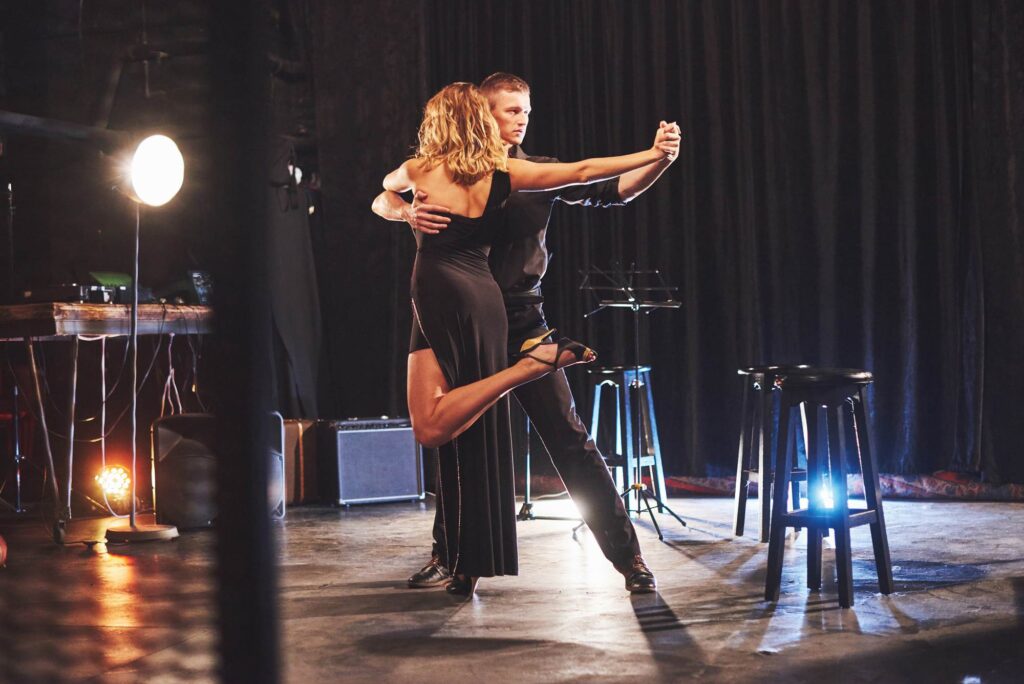
The human body is a machine of immense complexity, beauty, and harmony. The more we understand it, the more respect we have for it. We should never go against it or condemn it; we must take care of it. When the body moves, it just moves—you don’t always know why. For example, when you take a step, you simply move your leg without consciously thinking about it. The brain gives the order, and the body obeys.
When we start learning the first steps of tango, our mind has to adapt to movements it has never made before. Over time, and with repetition, these movements become automatic, much like when we learn to drive a car. At first, we think about every action, but with practice, we drive without consciously thinking about each movement. In the same way, tango becomes something natural. That’s why having a good teacher is so important: if the brain automates an incorrect movement, it becomes a «bad habit.»
Through continuous practice, we eventually dance without thinking about the steps, just as we walk without thinking about our movements. Each person has their own unique way of walking, and in tango, each person has their own style of dancing. This is shaped by how we learned and, most importantly, by who we are. (We don’t dance as we appear; we dance as we are).
If we need to correct a movement that’s done incorrectly, the brain must modify the already established pattern, which is much more difficult than learning it right from the beginning. This is why having a good teacher is key. Learning comes from repeating movements over a period of time, which varies based on the innate abilities of each body. Experts say that mastery is achieved after 10,000 hours of practice (Malcolm Gladwell, *Outliers*)—equivalent to practicing 4 hours a day, 5 days a week, for 10 years.
Just as we learned to crawl before we could walk, run, and develop physical skills as children, in tango, we must first learn to move while embraced, walk in tango, improve our balance, shift our weight, and finally, learn intricate figures, steps, and embellishments. If we start by learning figures instead of walking, the effort will be greater, the result will be clumsier, and bad habits will develop.
Patience and perseverance are essential in learning tango. You can’t assume you’ve mastered a movement just because it worked perfectly once. It needs to be repeated many times, under the guidance of a teacher, until the mind fully absorbs it and the movement becomes automatic.
The learning process is something we all have to go through. Some people can pick up several steps simultaneously, while others need to learn them sequentially. But in all cases, progress depends on how well the mind and body understand and practice each movement until they are mastered.
Those who skip this process will end up learning on the dance floor and will likely be judged by the tango community as such. They might never be considered great dancers, even if they later refine their technique.
Effort has its limits, and they are defined by the unique characteristics of each body. We need to recognize these limits and avoid pushing ourselves too far so that we don’t suffer but instead enjoy the activity naturally through practice and exercise. For example, if the body cannot naturally dissociate, forcing it to learn “backward ochos” with dissociation will slow down the learning process and may even harm the body.
A teacher must provide alternative movements to students. This is also part of spreading tango: those who struggle too much might see it as too difficult and give up.
**When the Connection is Achieved: The Fusion of Mind and Body**
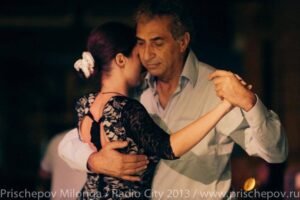
The body and mind are not two separate entities; the body is the external part of the mind, and the mind is the internal part of the body. Whatever happens in one affects the other. Every time we learn a new step or movement, our mind learns it along with our body, forming a pattern of movements.
The more we force our body, the longer it will take to learn, as the mind needs more time to create the new movement pattern. During this time, the mind remains occupied, preventing us from fully enjoying the dance. However, if learning occurs naturally and without excessive physical strain, the goal is reached faster, and the mind is freed to enjoy other aspects of the dance.
When the mind has created the movement pattern and the body performs it automatically, the mind is freed to enjoy the embrace, the music, the harmony of movements, improvisation, seduction, and love… for just three minutes—the length of a tango, a short moment but one of great pleasure.
This is when the soul enters, and we achieve the fusion of body, mind, and soul, reaching the ultimate joy (Osho). It’s hard for me, or anyone, to explain such a feeling—just as it’s difficult to describe the color red to someone who is blind. But it’s possible to guide people to experience this feeling and enjoy the sublime pleasure of dancing.
Since the supreme goal is not widely understood, some believe they’ve reached it, thinking they’ve achieved everything. But we’re all wrong, myself included. We never reach “everything.” Tango and the dance itself always surprise us, giving us more reasons to enjoy it.
I will continue sharing my experience with those who wish to achieve a relaxed, seductive, and deeply enjoyable dance, regardless of with whom or how they dance. The goal is to feel each second with an open heart and a present soul.
Engineer Carlos Neuman
YouTube, FaceBook, Instagram, Tik Tok: @airesdemilonga Whatsapp: +54911-27455194
ARTICLES RELATED
The tango dancing: articles list
Milonga and dancer tango codes