
 Insights from Decades of Experience on Milonga Dance Floors in Buenos Aires and Worldwide
As a milonguero with vast experience on the dance floors of Buenos Aires and other countries, I’ve come to deeply understand the follower’s experience in the dance. Generally, I can summarize that most appreciate a soft, sensual, and delicate tango. For this, the subtle and unmistakable lead of the leader’s role and the gentle response of the follower’s role are essential. Body balance is fundamental; it’s not about leaning your weight on the other, but about a support of torsos with a balance of forces, like two standing cards holding each other up – a purely physical principle for the milonguero style where a single axis is shared. In contrast, for the salon style, where each maintains their own axis, balance is individual.
However, in tango, no one holds the absolute truth. Each dancer, teacher, and enthusiast dances, teaches, and shares their opinions based on their own knowledge and experience. No two people are alike; each person is as unique as their own dance style.
In social tango dancing, there are no unbreakable rules, but rather guidance; there are no pre-established choreographies, but pure improvisation. Someone who dances to show off focuses on their movements, the number of figures, their posture, and how they’re perceived by observers. Conversely, someone who dances for their partner values the quality of the connection and the feeling. The leader’s role doesn’t just guide; it also accompanies. The follower’s role doesn’t just follow; it also actively accompanies.
Social tango dancing isn’t done simply for the sake of dancing; it’s done to enjoy, to feel, and even to improve one’s health. It’s not about professional performance, but a social interaction. The leader doesn’t think about themselves, but about the person they’re embracing, whom they protect with their embrace and improvisation to avoid collisions. The follower doesn’t dance for themselves, but for their current partner. The dance is not an individual action; it’s an experience for two. And, fundamentally, you don’t «take» your partner; you embrace them.
The Soul of the Embrace
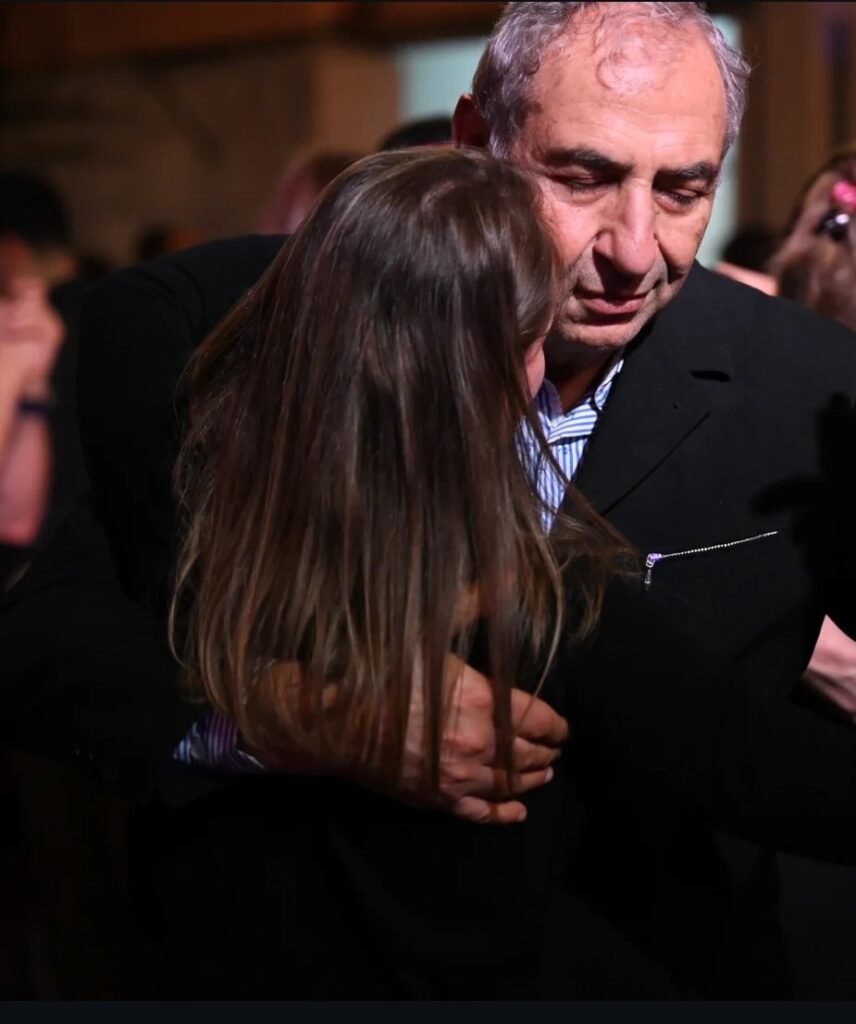
Obviously form me, a good, soft, and heartfelt embrace is the soul of tango. The leader’s embrace should offer containment, protection, and security, encompassing the partner’s back; it’s not an embrace for exhibition. Posture is key: the torso is offered, where the heart resides, without breaking the axis, which can be vertical or inclined with a stacked body. While an upright and elegant posture might serve to present oneself to the public, the essence lies in the internal connection.
For the follower’s embrace to be heartfelt and warm, they must feel the partner’s back along the full extension of the arm. It’s important that if the embrace involves the elbow pointing down, it doesn’t block the leader’s embrace or put the body’s weight on their arms; the leader is not their support.
My feelings about embracing the follower role:
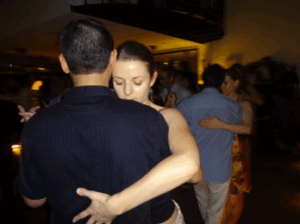
Basically, an embrace with the hand resting on the man’s right kidney is unesthetic and doesn’t allow for a deep connection.
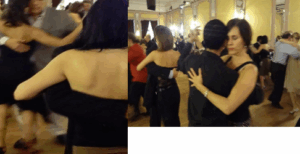
Furthermore, an embrace forming a «V» shape with the elbow as its vertex (elbow down) often blocks the leader’s embrace and prevents a deep connection. It also forces the dance into an open embrace with bodies leaning in a «V.»
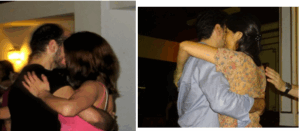
Open embrace with a horizontal arm that lifts off the follower’s back, where only the hand rests, doesn’t feel like an embrace, but just a hand.
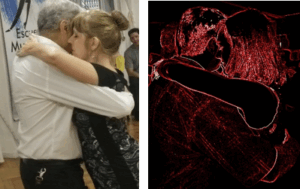
Ultimately, both desire to feel a good embrace, just as tango dancing demands! Women appreciate a good embrace, and so do men.
Naturalness and Flow in Dancing
Tango is easier than it seems if approached naturally, learning to «walk» it with the same unconscious bodily intentions we habitually and naturally perform in daily life, like walking down the street. This avoids difficult postures and movements that our mind and body struggle to assimilate.
As Osho says, «when the mind and body merge, the soul enters the dance.» That is tango. For the soul to enter, there must be connection. And for there to be connection, you shouldn’t think about anything; just feel, enjoy, and love for three minutes the person you are embracing. There will never be connection or soul entry if the mind is busy thinking about the sequence, the step, the legs, the movements, the people watching, or any other thought. We cannot see our legs while dancing; we only feel our bodies, the connection, and the musicality.
Harmony and Respect on the Dance Floor
In dancing, it’s about adapting to each other to finish the tanda with a smile and satisfaction.
One doesn’t impose one’s own dance, but rather it’s shared. One doesn’t impose a style, but rather adapts to one another, or the more experienced adapts to their partner.
Even if there wasn’t harmony in the dance, the entire tanda is danced, because one invited and the other accepted.
On the dance floor, one dances and that’s it. There’s no teaching or practicing; one doesn’t block traffic by standing still without dancing or showing off step skills.
One doesn’t walk across the dance floor between couples; one respects the other dancers, and even if the dance floor is empty, one tries not to invade it.
The leading role must orderly manage their space and the space shared with other couples, and the following role must adapt their movements to the existing space.
Dance partners are the ones who truly define the quality of the dancer; let’s dance for the partner in question, not for the people watching.
By Eng. Carlos Neuman of Aires de Milonga